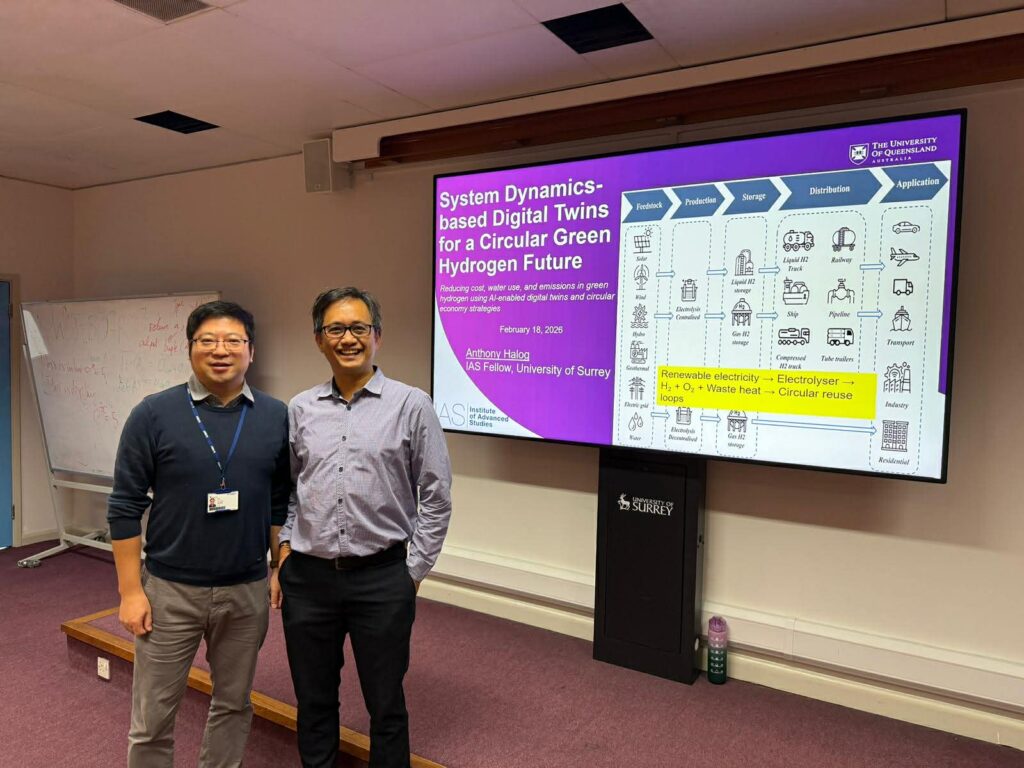
Dr Anthony Halog’s Fellowship research focused on sustainable energy and the need to build cleaner and more efficient energy systems to produce green hydrogen. By developing a ‘digital twin’ – or a ‘virtual copy’ – of a real system, he could put concepts to the test before implementing them in real-world situations.
Collaboration was at the heart of his Fellowship, bringing together academics from chemical engineering, sustainability, civil engineering and business to encourage an interdisciplinary approach to tackling the issue and enabling a workable real-life solution.
The Fellowship has already sparked further collaborations, research projects and funding opportunities, all of which should have a positive impact on clean energy production across the world.
We talked to Anthony about his research and his Fellowship experience at IAS.
Green hydrogen is a clean energy fuel made by splitting water into hydrogen and oxygen using renewable electricity like wind or solar. It produces almost no emissions, which makes it very attractive for tackling climate change.
But it’s still early days. Today, green hydrogen is expensive compared to fossil-based alternatives, largely because renewable electricity and electrolyser technologies are up. It also needs large amounts of water and infrastructure, which can be challenging in some regions. On top of that, integrating hydrogen into existing energy systems – transport, industry, storage – is complex.
So, the big challenge is not just producing hydrogen, but making the entire system efficient, affordable and scalable. That’s why we need smarter, system-level solutions – not just better technology.
Because we’re at a turning point. Green hydrogen is growing fast globally, but if we scale it inefficiently, we risk creating new environmental and economic problems.
AI acts like a smart brain – it can optimise how hydrogen is produced, predict energy demand and reduce waste in real time. Meanwhile, circular economy thinking ensures we don’t waste valuable resources. For example, instead of discarding oxygen or heat from hydrogen production, we reuse them.
Why now? Because investments in hydrogen are accelerating globally, and decisions made today will shape systems for decades. By combining AI and circular economy principles, we can build smarter, cleaner and more resilient energy systems from the start – rather than fixing problems later.
Imagine having a digital version of a hydrogen plant where you can test ideas safely before applying them in the real world.
In green hydrogen, this is incredibly powerful. We can simulate different scenarios – changing energy inputs, costs or environmental conditions – and instantly see what works best. It helps us avoid costly mistakes, improve efficiency and reduce risks.
Digital twins are especially useful because hydrogen systems are complex and connected to many other systems – energy grids, water supply and industry. By modelling everything together, we can make smarter, more informed decisions.
In simple terms, it’s like having a flight simulator – but for energy systems.
It made the research far more real and impactful. Instead of looking at hydrogen purely as an engineering problem, we brought together expertise from AI, sustainability, business and policy.
This meant we could ask bigger questions: Will industries adopt this? What policies are needed? How do we make it economically viable?
By working across disciplines, we developed solutions that don’t just work technically – but also make sense socially and economically.
That’s the key to real-world impact. Sustainability challenges are not just technical – they’re human, economic and systemic. Bringing these perspectives together helped turn ideas into actionable solutions.
This is where it gets exciting. The digital twin becomes a practical decision-making tool for industry, investors and governments.
Instead of guessing, decision-makers can test strategies in a virtual environment – like where to build hydrogen plants, how to reduce costs, or how policies might affect outcomes.
It reduces risks, saves money and speeds up innovation.
In fact, digital twins are increasingly seen as essential for managing complex systems and improving sustainability outcomes in real time.
So, it’s not just research – it’s a bridge between science and real-world action.
AI will become the ‘central nervous system’ of future energy systems. It will help balance supply and demand, optimise resources and reduce waste across entire industries.
Digital tools like digital twins will allow us to simulate and manage complex systems – from cities to global supply chains.
This transformation goes far beyond hydrogen. It will affect energy, transport, agriculture and manufacturing.
In short, we are moving toward smarter, more connected and more adaptive systems that can respond dynamically to environmental and economic changes.
That’s how we make net-zero not just possible – but practical.
There’s strong momentum coming out of this Fellowship. We’re already exploring joint research projects, funding proposals and long-term collaborations between the UK and Australia.
Areas include hydrogen digital twins, circular supply chains, ESG-driven energy systems and hydrogen infrastructure planning.
There are also exciting opportunities with major funding programmes like UKRI, Horizon Europe and ARC.
What’s most exciting is the interdisciplinary nature of these collaborations – bringing together technology, business and policy to create real-world impact.
The biggest highlight has been the people – working with brilliant researchers across disciplines.
Another highlight was developing the digital twin concept into something tangible and impactful. Seeing ideas come together into a coherent framework was incredibly rewarding.
And of course, the seminars and discussions – those moments where new ideas emerge through collaboration – were truly inspiring.
It’s those interactions that often spark the next big breakthrough.
Transformative, inspiring and energising.
The Fellowship allowed me to step back, think deeply and connect with experts in new ways. Most importantly, it showed how powerful interdisciplinary work can be in solving global challenges like climate change.
It’s an experience that doesn’t just advance research – it reshapes how you think about it.
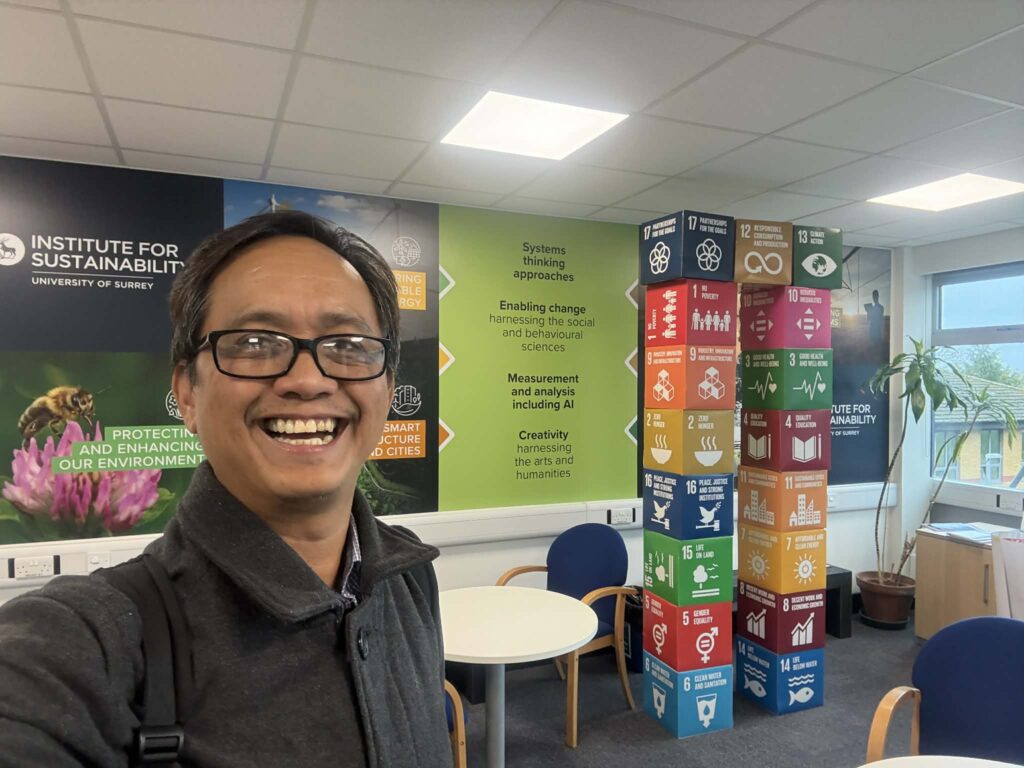
Back to Q&A features“IAS created a unique space where ideas could flow freely across disciplines. It wasn’t just about research – it was about collaboration, creativity and impact.”